DashCon 2014 was set to be an amazing event for Tumblr users, which was going to take place in Illinois. The idea here was to create a physical space for the blogging community to interact with each other. Given the premise, the event organizers were sure that they would have an average of 3,000 to 7,000 people in attendance, which would not only cover the operating costs but also help them turn a profit. But once the doors were open, it became clear that they had overestimated the size of their audience. Instead of the thousands of people they had expected, they now had about 300 to 350 people in the event. But that was not the end of that disaster.
The event organizers decided to lock some of the doors and inform the attendees that they had to raise at least $17,000 by 10 that night or the hotel would shut down the convention. The emergency meeting, coupled with some locked doors, pressured the attendees to hand over cash to keep the event going, which was a manipulation of its own. One bad decision after another quickly paved the way for this event to go down as an event management train wreck.
People who later investigated the incident realized that not only had the event organizers relied solely on online hype, but they had also failed to run targeted local campaigns and build partnerships that could materialize into demand for the tickets. A decade on, many event organizers still use this event as their baseline of what not to do when marketing an event.
But if the blueprint of mistakes to avoid is clear, what then are marketers doing to ensure that people actually turn up to their events, such that they do not have to resort to such horrible measures?
Event Marketing Strategies That Work
Having a valuable product is one thing. But getting people to see its value and part with money for it is quite another. That is why marketing is so important, not just for conventions, but also for other products in our society. So, how do event organizers get people to pay attention to their events?
Social Media Campaigns
The truth is that in this digital age, people are marketed to all the time, both online and offline. In fact, global estimates show that the average person comes across 4,000 to 10,000 ads a day!
Think about it. Whether you are browsing a website, watching a show on TV, looking at billboards on the way to work, or even just unwrapping packages, you are likely to come across an ad. And on social media, global estimates show that the average person sees at least 30 paid ads a day, on top of all the other unpaid ads they come across. Naturally, our brains learn how to filter through all these messages and only focus on what applies to us, which means that users only engage with a fraction of all these ads. Otherwise, they would feel overwhelmed by all the choices online.
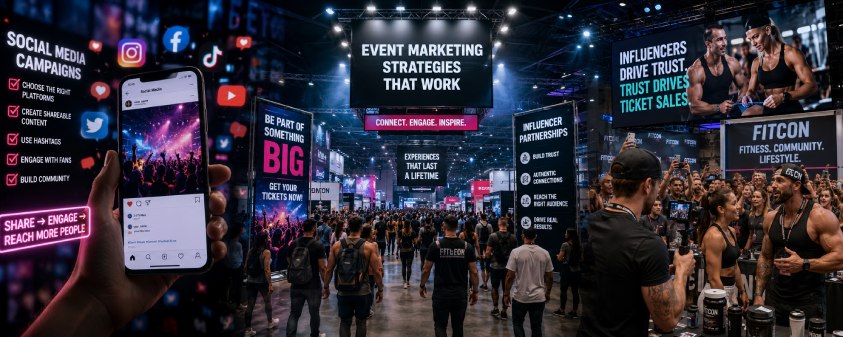
So, why does this matter? Seeing as social media users will often only pay attention to ads that speak to them, event organizers cannot afford to create an ad that gets lost in the sea of other ads. As such, they must be strategic in their plan. First, they choose the platforms that cater most to the fans they are targeting instead of just casting a wide net. Secondly, they come up with shareable marketing material, ranging from short videos to creative posters and catchy hashtags relating to the event, which they encourage their fans to share with other people. And finally, they invite people to engage with them through polls, filters, and other features that create a two-way line of communication between them and their fans.
If executed correctly, social media campaigns delegate the marketing to social media users. After all, the more that people engage with an event’s content, the more that the algorithm pushes it to other people who match the people engaging with it. To add to that, users are often eager to post shareable content on their own accounts. For example, if their favorite artist is having a concert, they may share it with other friends who may want to attend it. In this way, the social media campaigns create a chain reaction across the internet that helps event organizers reach more people faster and thus sell their tickets.
Influencer Partnerships
Recent surveys have proven that, on average, only about 12% to 22% of consumers trust traditional social media and banner ads. Why is that? For the most part, the distrust stems from the obvious transactional component, where the goal behind these ads is always to sell something to the consumer. To add to this, consumers are often overloaded with information and find these ads to be intrusive. Of course, older generations still trust these ads for the most part, and these commercials still play a part in building market awareness. But when it comes to generating and nurturing leads from younger generations, these ads are largely ineffective. That means that event organizers cannot wholly rely on them to sell tickets.
But if traditional ads are out, what can they use? Social media influencers! The same surveys that have registered a decline in traditional commercials have noted a sharp rise in consumer trust in these influencers. Based on recent findings, almost 80% of social media users prefer influencer content compared to traditional ads. However, the success of these marketing approaches heavily hinges on the authenticity of the influencer. Where an influencer does not disclose paid sponsorships or ads, then this trust falls. But even with these nuances, it is quite clear to event organizers that influencer partnerships are much more effective than spending money on traditional ads.
To make the most out of these partnerships, event organizers team up with influencers whose following matches the kind of people who would want to attend their events. But that is not all. They also seek influencers who have loyal followings and who have built a community around them rather than just having a large follower count. That is why many organizers often prefer working with smaller niche influencers who have strong ties to their communities rather than just big influencers who may not have a high trust rating from their followers.
To drum up hype for the event, the organizers send PR packages to these influencers who share photos and videos unboxing their event passes, which creates interest in the event. They also host ticket giveaways, explain what will happen at the event, share behind-the-scenes footage, and engage in all sorts of other marketing practices that pique the interest of their followers. And since their followers see them as friends, these recommendations feel more genuine compared to a traditional ad. This trust translates into ticket sales over time.
Example
FitCon is a fitness and wellness convention that invites fitness enthusiasts to take part in its Event Marketing Strategies. As part of its marketing strategy, it signs affiliate and promotional deals with top fitness creators. Some of the notable names who have been part of these sponsorships include Lean Beef Patty, Jay Cutler, Chris Heria, and Nathan Freihofer. These and other creators are able to share discount codes with their followers, who get to sign up for the events at a reduced price. To add to the hype before the event, these creators engage in activities such as posting their workout routines while wearing the convention-branded gear, talking about the fitness challenges in the event, or even sharing the booths they will be visiting. And since their followers trust their advice, seeing them hyped up for the event convinces them that they, too, should join in on the fun.
Fan Community Outreach
Big conventions come with many perks for both the attendees and the event organizers. To the fans, the bigger the events, the more opportunities they have to interact with other people who share their interests, the more merchandise that is available, and the more likely the organizers are to offer experiences that small conventions cannot offer, such as interactive booths. But while this may be the case, these events can also feel a tad greedy or out of touch with the fans. Why?
The vibe between a big convention and a smaller one can be worlds apart. For one, to some fans, big conventions start feeling like marketplaces that cater to the masses and ignore the smaller creators in favor of corporate booths that can pay for the best space in the venue. As such, this can make the fans feel like the events are inauthentic. Then, there is the lack of human touch. You see, when events are hosting thousands to hundreds of thousands of people, crowd control tends to treat people as units within the crowd. There is a lot of walking, ushering, restrictions, and the list goes on. So, what could have been a hub for casual interactions becomes this large traffic aisle that feels more like an institution rather than a community. And we also have to touch on the financial aspect. When an event grows bigger in terms of its capacity, fans often equate this to the organizer’s desire to sell more tickets, banners, and so on, which is highlighted by the increased fragmentation of the ticket tiers. So, it is not uncommon for fans to view big events as corporate or greedy, especially when the organizers seem out of touch with the real fans.
But that is where effective community outreach comes into the picture and changes it for the better. Unlike with ads, where organizers tell fans what is happening and where, community outreach requires them to go directly to where their fans hang out and interact with them on their terms. These spaces include Discord servers, fan clubs, Reddit, and other platforms where fans openly share their thoughts. The goal here is not just to post links to the ticket site but rather to talk to the fans and find out where their heads are at, what they want to see more of, the challenges they are facing, and the things that they care about. They do this by hosting chats and responding to comments. And as a show of gratitude for these fan communities, they offer their fans specials such as early ticket access or special discounts that show them that they value them.
Since fans feel respected and included in these outreach campaigns, they get the acknowledgment that they are not just units within a bigger crowd and that the organizers care about everyone who attends the event. So, people who would have been casual ticket buyers become supporters who are willing to promote the event to other people within and outside the fan communities.
Example
Dragon Con has an amazing relationship with its fans through its own Subreddit. Instead of trying to control the conversation, it leaves it open to contributions from fans, such that the organizers and volunteers embed themselves in the conversations. Through activities such as discussion threads, they are able to use the same space to not only inform their fans of upcoming events but also help them navigate the challenges that come with preparing for and attending the convention. The planning also extends to things such as coordinating the parade and greenlighting meetups. In many ways, the fans in these discussions become part of the advisory board rather than just customers, which helps explain why this convention has held on to its loyal fanbase even as its attendance numbers have been growing.
Countdown Marketing
EVO (the Evolution Championship Series), which is the world’s largest competitive fighting game convention, has added such a unique twist to countdown marketing that many other conventions have followed suit. You see, in the past, event organizers would post countdown timers on when events would start so as to create a sense of urgency among their fans, such as 50 days to the convention. But this soon became generic, and while it still served its function, it became a tad expected. So, conventions like EVO started thinking outside the box.
Particularly, EVO started using a phased approach. In the first phase, it would start dropping teasers on social media about the announcement show, when it would reveal the official tournament titles. This teasing would start even before ticket sales were open, which would leave fans curious about what they would be paying for once the tickets were available, which would start conversations in the fan communities. And true to their word, EVO would reveal the official titles in an exciting trailer that would cement fans’ motivations to buy tickets.
In phase two, EVO would start teasing the end of player registrations. Since this convention allows its attendees to actually compete in tournaments, it would make sure that fans were aware of the registration deadlines while reminding them what they would miss out on if they slept on the chance. They would even show the number of total registered players to put pressure on more players to sign up before the slots were filled. And in the third phase, which would take place after the convention started, it would change its focus from ticket sales to driving more engagement online. Thanks to this multi-layered approach, it has been able to drive hype before, during, and after its events.
Other conventions have used similar strategies, with the main idea being to address the procrastination that exists among fan communities. After all, since people love to put things off until the last minute, it is not uncommon for them to plan to buy tickets but wait so long that they forget about the event or lack enough time to make enough preparations to attend it. Countdown marketing creates urgency by showing people how much time they have available. What’s more, if paired with surging ticket prices or special events, it pushes people to act immediately instead of paying more for tickets later or missing out on deals.