

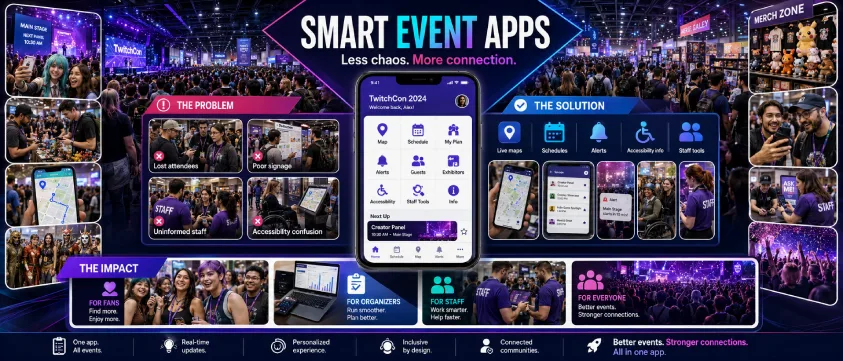
When Twitch viewers heard about the 2022 TwitchCon San Diego event, they were excited about the prospects of not only meeting the people they spent time watching but also the friends they had made online. To them, the event was all about connection, and they showed up in large numbers to the point that the San Diego Convention Center was recording daily foot traffic of about 30,000 people each day. But while the fans were ready to start capitalizing on their experiences, they started running into literal walls when it came to navigating the convention center. You see, the event staff and security personnel who should have known where things were seemed not to have a clue about directions and amenities.
How Event Apps Are Solving the Convention Chaos Problem
Thousands of attendees found themselves grappling with one logistical and navigational problem after another. If they asked event staff for directions to specific rooms, the staff would not know where these rooms were, point them in the direction of someone else, or send them in the wrong direction. So, many people found themselves running around in circles, thereby eating into the time they could have spent enjoying the convention. To add to the confusion, there was a lack of adequate signage that attendees could have relied on to navigate the venue without asking for help. And if that was not bad enough, disabled attendees noted that the staff were often unsure about accessibility rules in the venue and would have conflicting statements based on who you asked.
Much of this communication failure was because the convention heavily relied on temporary staff. As such, they had essentially tasked hundreds of workers to guide people even when they had minimal information about the event’s rules. Following the online discourse that ensued during and after the convention, many attendees noted that these issues could have been easily avoided if TwitchCon had upgraded its app to serve as more than a digital pamphlet and instead function as a navigational and informational tool that both they and the workers could have used.
Since then, we have seen an increase in the number of modern conventions that have been integrating apps into their events. Let us talk about how these apps are impacting convention experiences and why they will probably become a mainstay in the coming years.
What Roles Do Event Apps Play in Conventions?
The premise behind any convention is to create a memorable experience for the attendees. Whether they are attending the event to show off their costumes, see what new games are available, buy merchandise, or just meet their online friends, conventions are centered on having fun and making connections. These are the memories that people hold on to for decades. But if something goes really wrong, such as overcrowding in panel sessions or poor line management, then these mishaps cloud the entire experience for both the attendees and the event organizers.
To avoid such negative outcomes, many convention organizers have turned to the use of apps. Let us break down how these tools are able to address most of the bottlenecks in conventions and the impact that they have on attendees, the convention organizers, and all other parties involved, including the staff who often bear the brunt of event failures.
Scheduling
Have you ever thought about the reality of the scale of modern conventions? Most of these events are large-scale, such that they attract thousands of attendees alongside tons of vendors, celebrities, performers, and the list goes on.
Take the example of events like the New York Comic Con or the San Diego Comic Con. On paper, we see the list of attendees written in terms of 100,000 people going up. But these are just a fraction of the total number of people in the event. That is because to pull off such a huge event, organizers need an additional 10,000 to 30,000 people. These include exhibitors and vendors, convention staff and volunteers, catering, creators, panelists, security, medical personnel, press, and media.
But that is not all. A convention of this scale offers hundreds to thousands of activities spread over a few days. These tie to things such as celebrity panels, workshops, photo-ops, cosplay contents, gaming tournaments, screenings, social mixers, and the list goes on. So, you have hundreds of thousands of people participating in hundreds to thousands of activities, which can feel overwhelming even to someone who has been to tons of conventions. After all, how can they ensure that they do not miss out on their top activities, especially when there is a risk of overlap?
The Scheduling Effect
For years, convention attendees have been using paper booklets to keep tabs on activities and marking out the slots they do not want to miss. This work is not only bulky, but it also introduces the risk of missing out on an activity because its timing has changed, and yet that has not been reflected in the booklet.
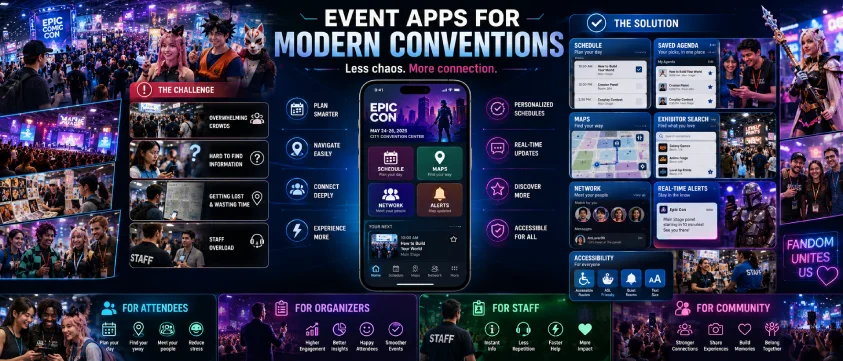
Modern event apps work like dynamic itineraries that allow attendees to review the whole schedule, filter events based on their preferences, and build their own agenda based on the activities in which they want to participate. This personalization allows them to hone in on what matters to them, such that they can figure out how to get everything done on time. These apps go further by syncing these personal schedules with changes in the master schedule. For example, if a panel gets pushed back by 20 minutes, attendees receive an alert as well as a calendar update, thus ensuring that they do not run into any surprises.
Thanks to this scheduling, attendees are able to avoid the natural overwhelm of figuring out what to do, and they can instead enjoy their experiences. And for event organizers, this pays off in two main ways. For one, they get positive feedback from their attendees who are able to create streamlined calendars. Secondly, their staff have an easier time fulfilling their roles because there is less chaos at information desks, as people know what is happening and where it is taking place.
Networking
Surveys conducted during entertainment conventions have revealed quite a heartwarming statistic – of all the people attending these events, a good 65% to 75% are seeking human connection above all else. Of course, they still care about the celebrity panels and the exclusive merchandise, but at the end of the day, they are searching for community. Broken down, the surveys found that 65% of the attendees wanted to meet new friends, 43% wanted to meet their online friends in real life, and about 15% wanted a romantic connection. How exciting is that?
But it is not just attendees who are out to network. We also have creators who want to pitch their ideas to publishers, businesses that want to talk deals with vendors, and the list goes on. And with all these different motivations, you can understand why weaving through thousands of people can feel unnerving. After all, how can you find the right people to talk to without relying on pure luck?
How Apps Bridge this Gap
Event organizers are well aware that much of their work revolves around bringing people together. As such, many of them have introduced digital community spaces in their apps, which serve as part of the main event. Here, attendees can find features such as chat rooms, attendee directories, and even matchmaking algorithms for those seeking connections. All they have to do is create a profile that highlights their interests, fandoms, and professional skills, and the app will do the rest by suggesting relevant connections and enabling them to schedule meetings within the venue.
These digital spaces work for all attendees, including the professionals who are out to make new deals. In the end, attendees find that they are no longer just passively watching others and are instead ingraining themselves in the communities, which allows them to forge connections that can last beyond the event. And since attendees are often in these events to make friends, these positive experiences shape the reviews that they leave afterwards, which is to the advantage of the convention organizers.
Example
While the TwitchCon 2022 in San Diego may not have gone as smoothly as expected, they have made some changes to their app that have been welcomed with open arms. And the main feature that gets a lot of praise is their networking. Not only does it allow attendees to request meet and greet sessions with creators, but it also enables them to build custom profiles with which they can connect with other attendees, streamers, and professionals in the industry.
Digital Maps
The Anime Expo (AX) 2023 at the Los Angeles Convention Center had people talking for weeks, and it all had to do with how the event had handled its influx of more than 390,000 attendees, many of whom ended up lost inside the venue! So, how could this happen? To start with, the crowd was so big that attendees would find themselves being swept in the direction of the crowd’s general momentum, which often left them far from their destinations.
Additionally, since the venue itself is huge and comprises several wings and concourses, attendees found themselves getting lost during the transitions. One wrong turn was all it took for many of them to end up in a loop where they kept coming back to the same place. In other cases, some of the attendees found themselves walking through unmarked service corridors without knowing where they were going. And those who tried calling for help soon found out that the cell towers were so overloaded that many people did not have connections within the venue. So, they could not pin their locations or even use the GPS to find their way back. Add the sprawling and confusing lines, and the event was simply chaotic.
While this incident may seem out of the norm, the truth is that most convention centers are often hard to navigate. It is quite common for attendees to get so lost that they miss the panels they paid to see. It is also quite possible for some locations within the venue to have so much congestion that attendees run the risk of getting hurt while in them. Such incidents not only hurt the attendees’ experiences but also the vendors and creators because they can easily get overlooked in congested locations. After all, when people can barely tell which direction is right, they do not really have the time to go through exhibitions.
Simplifying Navigation through Apps
A big reason people get lost in venues is that they have to rely on static maps. And that means that if they fail to make the right turn or cannot quite place where they are, then they end up lost. Apps feature interactive maps that allow attendees to type in the locations they want to go to so that they can receive instructions on how to get there. For example, if an attendee wants to visit a specific vendor, they can key this into the app and get the information on how to get there. Some of these apps are so advanced that they feature beacons that show attendees where they are in real time so that they can easily make their way to their destination, just like they would do with GPS.
Interactive Maps in Action
As things stand, many modern conventions are seeking ways to use interactive maps as part of their apps. And some of them are borrowing a leaf from Penny Arcade Expo (PAX), which has been using interactive maps to its advantage. Within the app, attendees are able to view floor plans, locate amenities, and even search for specific exhibitors. And since the maps are cached within the app, they work even when attendees are offline, which solves the challenge of poor connectivity during busy conventions.
Another feature that stands out with their app is the constant updating since the expo updates it weeks before each show, thus making sure that the information available is accurate.
Push Notifications
For the most part, event organizers do their best to refine their event schedules before selling tickets, as this enables attendees to know what activities will be taking place and who will be there. Even so, it is not uncommon for organizers to make schedule changes twice or three times before the event. Usually, this is not an issue. But it becomes a problem when the changes start taking place on the day of the event, when attendees have already made it to the convention.
You see, conventions revolve around people. And try as the organizers might to ensure that everything runs according to schedule, things can change at the last minute. Guests can cancel, forcing the organizers to find replacements or shuffle panels. Panels might attract so many people that they may have to be split into several sessions or moved to other rooms. Celebrities can run late, which would push back their autograph and photo-op sessions.
These are but a few examples of the things that can go wrong and which would affect the overall schedule. And when attendees are using static schedules to keep track of their itineraries, they can miss out on all these changes and head to events, only to find that the timing or locations have changed.
How Push Notifications Ease Communication
Schedule changes can have negative impacts on the people in the event if they are not communicated effectively. Not only can they lead to confusion, but they can also pave the way for rumors. Event apps ensure that these and other outcomes do not happen by allowing organizers to send targeted alerts to the attendees affected by the change.
For example, if a specific panel is the only one affected by a change, then only the people who signed up for it or marked it in their schedules will get the alert. But where an issue affects everyone, then the alerts will show up on everyone’s lock screen, thus ensuring that people only get the information that they need, so as to avoid overwhelming people with alerts.