

A study conducted by Microsoft Canada in 2015 reported that the average person could only focus for 8 to 12 seconds on an uninteresting task. But while some people took this statistic and ran with it, cognitive scientists decided to put it to the test. In their findings, they realized that this span only measured the time it took for people to lose focus on unengaging tasks, such as repetitive media, but did not reflect a person’s ability to focus.
Subsequently, they found that the actual adult attention span was about 47 seconds if the person in question was constantly being interrupted by notifications or had their attention pulled in various directions, such as scrolling on social media. Regardless, this was a significant decline from the 2.5 minutes that was the average in 2004.
But what about when an adult is actually engaged in the activity? Well, findings showed that the attention span increased dramatically and ranged from 10 to 20 minutes, thus proving that people could concentrate for much longer than had been previously alluded. What’s more, in cases where the adult in question was deeply engrossed in the task, their attention could last for anything from 40 minutes to several hours. Therefore, scientists came to the conclusion that our attention spans were subject to not only what we were doing but also our environments.
Naturally, industries all over the world started using these insights to build better experiences for their clients, be it in schools or supermarket chains. And it was not long before conventions started changing the way they approached their activities in a bid to ensure that their audiences were not only interested in the said activities but were also minimally distracted during the events.
Let us see how they achieve this in this modern age:
Why Engagement Matters in Conventions
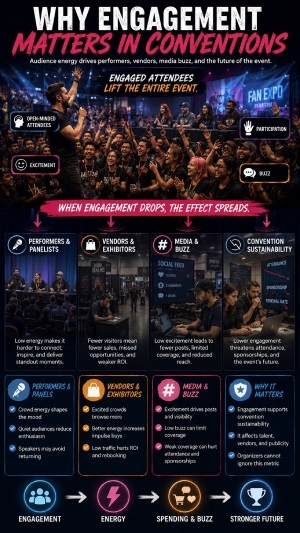
Conventions have it easy when it comes to engagement because attendees come to the events with an open mind and an eager spirit. Even before the doors open, they are often already excited about each of the activities on their schedules and are thus able to take things in their stride without getting derailed by mishaps here and there.
But even so, attendees are still human. That means that if you leave them unengaged long enough, this has a ripple effect on the whole convention. How?
To start with, unengaged audiences put a damper on performances and panels. After all, performers rely on the energy of the crowd, such that if the audience is silent or unresponsive, this can make the performers less enthusiastic. And in panels, this awkwardness can make the panelists hold back on engaging with the audience because they do not want to keep getting subpar or no responses. But the effect does not end there. Entertainers and speakers who encounter such an atmosphere are unlikely to book with the convention again and may prefer to go to other spaces where they feel more welcome and appreciated.
This effect also trickles down to the vendors and exhibitors. You see, many of the purchases that take place in conventions rely on the enthusiasm of the crowd. When people are happy, they are more likely to interact with the vendors and make purchases, including impulse buys. But when they are feeling lethargic, they move around much less and choose to linger in one place or leave early, which reduces the foot traffic in the exhibitions. And when they are in this headspace, they are less likely to buy things from the vendors and creators in these spaces. As you can imagine, vendors who do not see a high return on their investment are unlikely to pay for event space the next time around, as they do not want to incur losses.
It also does not help that the media assesses conventions based on the kind of buzz that they generate. That means that if people look unenthusiastic and are barely posting the event online, the media assumes that the event was not all that exciting to begin with, and they may choose not to cover it or bury it in the standard posts. And this affects the convention both in terms of future attendances and sponsorships, as both can decline following such poor coverage.
So, no matter how you look at it, audience engagement determines the sustainability of conventions, which is why event organizers cannot ignore this metric.
The Most Effective Interactive Approaches
We can all agree that audience participation is important. At the same time, we can also get on board with the fact that some strategies just do not work and can, in fact, make things worse. Take forced icebreakers as an example. In such cases, the hosts force attendees to engage in activities that cause them distress, such as standing up, holding hands, or sharing personal details with strangers. While these may seem like a great idea in the moment, they create tense environments where people feel embarrassed and anxious. And some people may even choose to leave the session just to avoid being put through that again.
To avoid such terrible outcomes, event organizers focus on the following approaches:
Interactive Question and Answer Panels
Panels are a mainstay in the convention world as they allow fans to hear from experts in the industry who share gems with them. But while they serve as a window into key processes, these panels have been known to be monologues where the guest speakers take the reins and direct the conversations, leaving the audience to listen and observe. After a while, the excitement of seeing the guests dies down, and it is not uncommon for the audience to feel disengaged from the whole talk because it is akin to sitting at home and watching a video. So, their attention can start to wander, thus impacting their experience.
That is why many conventions have transitioned to question and answer (Q&A) panels where the audience gets to be part of the panel. How? Well, in the past, panels would leave a few minutes at the end of the session for a few rushed questions. But now, conventions are weaving the questions into the entire session. To get the process started, the panel organizers allow the audience to submit questions through the event apps. Here, other attendees can see which questions have been asked and can vote on the ones they would like answers to, thus ensuring that only the questions with the most votes make it to the top of the list. This way, by answering these popular questions, the panelists can cater to most of the issues that are common to the audience.
Not all questions go through this voting process. To make sure that the panel feels open, panelists will often pose random questions to the audience and will have staff members pass microphones around to the people who want to speak directly to the guests, thus making the experiences more interactive.
In the end, fans feel validated by listening to experts answer questions that relate to their interests. And since most people want a chance to talk to the panelists whom they admire, they remain active in the voting process and keep an eye out for the mics. So, panels stop feeling like passive experiences and become active events for everyone in the room.
Live Polls and Votes
Conventions often attract thousands of people, and in such settings, it is easy for individuals to feel like just another face in the huge crowd. This effect is especially stronger in cases where attendees barely have a say in the goings-on at the event. And so, they feel that regardless of whether they are there or not, they do not have an impact on the convention, which can hurt their emotional investment in the processes.
While convention organizers cannot practically involve all attendees in the event planning processes, they have found that they can invite them to participate in the decisions made during the events, such as during panels and presentations. For example, during panels, moderators can allow the attendees to vote on things such as the topics of discussion, what videos to watch, and which scenarios the guests can react to. All they need to do is project a code on the screen or share a link where the audience can find all the options and choose what they want. As the audience votes, they can see the live results either on their phones or on the main screen, which helps them feel like they are part of the contest.
Beyond discussions, conventions have also been holding live contests where their audiences are able to vote on aspects such as who has won the live debate, who completed a challenge best, and so on. These and other instances create settings where individual opinions matter, thus enabling people to feel like they have ownership over their experiences. They also pave the way for collaboration between people, which breaks the ice and enables people to strike up conversations with each other.
Now, here is where it gets interesting. Conventions are also able to use these voting experiences to gather information about overall preferences, which they can then rely on when planning future events, thus creating experiences that align with what the audience actually wants.
Cosplay Competitions
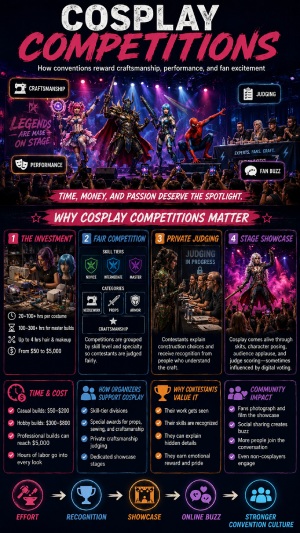
Making a single convention costume can take anything from 20 to over 100 hours, and for the master-level builds, we are talking about anything from 100 to over 300 hours. To add to this, hair and makeup take up more hours on the day of the convention, with some attendees spending as many as 4 hours to put their looks together. And when it comes to costs, casual cosplayers get away with spending a range of $50 to $200 on their outfits, while hobbyists can spend between $300 and $800. Professionals skew the averages by investing thousands of dollars in their outfits, some of which can cost as much as $5,000.
That is all to say that, regardless of their level, cosplayers invest a lot of time and money in their costumes. So, you can imagine how they would feel if they walked into a convention only to feel like their work was going unnoticed and was limited only to the people they walked past in the hallways.
Luckily, convention organizers do not let that happen and have found a way to center their events on these costumes. First, they categorize their competitions based on skill tiers, such that the novices compete with novices, the Masters face off with the Masters, and so on. But rather than just focusing on skill levels, they also break down categories based on various aspects, such as needlework, props, and other features that are integral to a good costume. This way, cosplayers can get awarded for the things in which they excel.
Secondly, they allow the contestants to meet with private panels where they can explain their costumes in detail to expert judges. Here, they can get into detail about materials, techniques, and other factors that may not be obvious to people who do not make costumes. And in this way, they get an emotional reward for all their hard work, as they get to talk to people who understand and appreciate craftsmanship.
Last but not least, conventions have showcases where contestants are able to show off their costumes to an eager audience. To make the presentations stand out, contestants often put on a short skit with music and lighting that shows off the character’s personality. In most cases, the scores are determined by the judges, but they can be influenced by digital votes or applause from the crowd.
Given how much convention attendees appreciate visuals, they are known to take photos and videos of the cosplay competitions and share them online, which creates buzz around the competitions and fosters discussions about cosplay as a whole. Thus, even people who may not engage in cosplay get to be part of these events in one way or another.
Workshops and Hands-On Sessions
Research conducted on learners has revealed that students who are part of passive learning environments are 1.5 times more likely to fail. But those in active learning environments are not only likely to have 6% higher exam scores but also boast an overall retention boost 54% higher than that of students in traditional lectures. These studies have confirmed what we have known all along, and that is the fact that not everyone learns or engages effectively by only listening and watching. If anything, for tactile learners, passive lectures fail at garnering their attention because what they want to do is be part of the process.
These same aspects show up in conventions. Most attendees do not just want to sit back and listen to someone else explain how things should be done. They want to be part of the creative process, and that is why many conventions feature workshops in their events. Top among these are guided classes led by industry professionals. Here, an expert, such as a prop maker or a book artist, hosts a small class where they guide the attendees on a specific project. Each attendee receives the tools necessary to complete the project, such as a piece of foam for a prop class or a drawing tablet for an art class. Then, they follow the instructions of the expert who walks around the room reviewing each person’s work and offering them tips on what they can change or do better. Attendees who are eager to expand their skillsets often sign up for these interactive sessions because they enable them to master new techniques and ask questions that they may have been harboring before the event.
The audience engagement in these sessions is quite high as attendees walk away having gained practical value that they can rely on in their personal as well as professional exploits. So, as much as they do get to enjoy the fun of the convention, they get to use it as an educational platform that broadens their insights, which is unlike the case with passive interactions.