

The entertainment industry would not be what it is today were it not for fandom communities. Think about it. The typical fan enjoys the content they like, and once they are done, that marks the end of their experience. Be it a show, movie, music band, or sport, they gravitate towards what they like, consume it, and call it a day. But a fandom goes beyond this. Rather than casually enjoying content, they create a culture around it that revolves around interacting with and dissecting it long after they are done consuming it.
Take Trekkies, for example. They are so devoted to the Star Trek franchise that they went as far as organizing campaigns to save the show when it was close to getting cancelled. But their devotion does not end at these campaigns. It extends to their willingness to attend global conventions, write fan fiction regarding the franchise, and even learn the fictional language, Klingon, used in the franchise. As such, they serve as one of the top fandoms in the entertainment industry, with at least 3 million Trekkies engaging in Star Trek’s main hub on Reddit.
Trekkies are not alone in their commitment to the franchise and their significantly high numbers of devoted fans. We have many other amazing examples of global fandoms, including BTS A.R.M.Y., who go hard for the South Korean pop group BTS, Swifties who organize streaming campaigns to boost Taylor Swift’s charts, Potterheads who would stop at nothing to protect the franchise, and the list goes on. From these and more examples, it is clear that fandom is not tied to one entertainment genre, artist, or show. In fact, going by current statistics, online fandom hubs host hundreds of thousands of communities, which host as few as tens of people to as many as millions of people.
But does fandom translate into revenues? Let’s find out.
The Impact of Fandom Communities on the Entertainment Industry
From the outside looking in, it may look like fandom communities exist just to keep the subcultures that they are part of alive. And while that may be true to some extent, the truth is that these communities also serve as the foundation for the entertainment industry. After all, their overall behavior plays a vital role in injecting revenue into this industry in the following ways:
Buying Merchandise
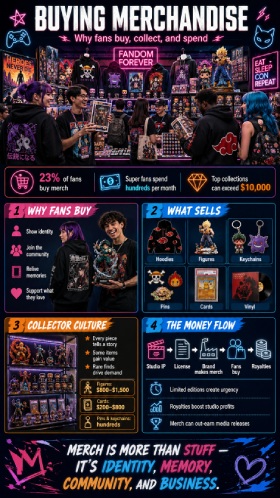
Global averages show that about 23% of general fans actively buy merchandise relating to the content that they love. But when it comes to super fans, the percentages go up. In fact, the average super fan can spend hundreds of dollars in a month on merchandise, and some are so dedicated to their collections that they have merchandise valued at over $10,000. And when you go into the niche fandoms, you find that fans in these communities will often spend hundreds of dollars on unique collections, such as figures.
So, what exactly are fans buying? Well, the items vary from hoodies to statues to keychains, as it all depends on the subculture in question. But, regardless of the items available, we cannot have a discussion on costs without talking about why fans would be willing to spend money on the merchandise.
For the most part, fans buy these items because they help them communicate their identities and passions with the world. Say, for example, that someone loves an artist, then wearing a hoodie branded with their name serves as their way of aligning themselves with them. At the same time, merchandise allows fans to signal to others within the community that they are part of them. Besides, it plays a part in nostalgia because fans can use those items to remind them of specific events, such as that one time they went to a concert and listened to their favorite band playing.
At the end of the day, merchandise is not really about the physical product, but rather it serves as a way to connect with oneself and with others.
A Note on Collector Culture
While some fans only buy occasional merchandise, some are very serious about their collections. Whether they are collecting comic books, trading cards, or vintage vinyl records, they do so deliberately, such that each piece tells a story. Therefore, what they end up building is more of an investment portfolio that gains value with each addition. In fact, some of these collections are so valuable that they are tradeable in the same way that people sell their art or stocks.
So, how valuable are they? Well, it all depends on the merchandise ecosystem in question, seeing as fandoms vary widely. For example, anime and pop culture figures can attract a market value of between $800 and $1,500, yet trading cards can come in at between $200 and $800. Mass market items, on the other hand, such as keychains and pins, often have a value of several hundred dollars.
While the average fan may not turn a profit from their investments, collectors who are able to buy items that can outpace the hype and inflation are able to do so. Even so, you find that most collectors do not do it for the money but rather for the joy it brings to them.
The Financial Impact
Entertainment studios rarely make the merchandise themselves. Instead, they often license their intellectual property, thus allowing other brands to buy these rights, make the products, and sell them to fans at a profit. And since these brands want to get a high return on their investment, they are often willing to engage in scarcity marketing, where they make limited editions or rare items that will fetch a high market price.
Ultimately, the entertainment studios turn a huge profit on their licenses because, in most cases, they do not sell them for a flat fee and instead also include royalties on every item sold and also cap the licensing periods, thus enabling them to sell the same licenses to other brands after a given period or in another region at a higher rate. Pokémon is a great example of this because, as much as its games and shows are very popular, you find that most of its revenue comes from its licensed merchandise.
Convention Tourism
The last Comiket in Tokyo, Japan, drew over 300,000 fans over the course of two days, thus averaging a whopping 150,000 people per day. And when the Lucca Comics & Games took place in Lucca, Italy, in late 2025, the event organizers were able to sell 280,000 tickets. Of course, that number pales when you feast your eyes on the last Anime Expo in Los Angeles in 2025, which had over 410,000 attendees! You get the idea here – fans love conventions. But why?
Online fandom communities are great by themselves as they allow fans to interact frequently with others who share their hobbies. But while they serve as a convenient outlet, they can be incredibly isolating, seeing as the interactions are virtual. That is why many fans are willing to travel to conventions where they can meet the people who create the content they love, show off their costumes to an audience who will appreciate them, and escape into this alternate world where they are part of the very shows or bands that they love.
The Financial Impact
On the surface, we see the revenue generated from ticket sales at conventions. But the truth is that these events are massive financial ecosystems that impact more than the event organizers. How so?
For one, we have the vendors who get to turn a profit by selling their products to a ready market. Then, away from the venue, we start seeing the financial impact of the event on other businesses. Hotels and short-term rentals get to accommodate these visitors, restaurants experience an influx of tourists, taxi companies and other transport services get access to a whole new market, and the list goes on and on. And given that these conventions often attract tens to hundreds of thousands of fans, it is quite easy for a single weekend to translate into millions of dollars in the local economy of the city hosting the convention.
San Diego Comic Con is a great example of this. You see, this event is so popular that even when people are unable to get an official badge for the main Convention Center due to limited capacity, they still show up and attend the events that are accessible without these badges. And we are talking about at least 130,000 attendees who can get a badge, plus the tens of thousands who will head to its satellite locations. So, at the end of every event, not only do convention organizers walk away with a tidy profit, but the local economy also sees a boost in consumer spending that benefits its residents.
Creator Economies
Mainstream studios understand that fandom communities want a steady stream of content. But while this may be so, they cannot pump out new content continuously, as they have to be strategic with their approaches. For example, to shoot a movie, the studio must develop a storyline, cast people for the roles, shoot the content, edit it, market the new movie, and so on. And so, by the time that the movie is ready for showing, fans might have had to wait a year or more.
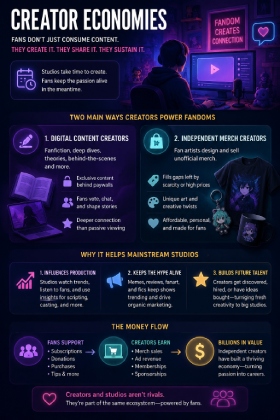
Naturally, fandom communities desire something else to keep their passion alive as they wait. As such, many of them have turned to independent creators who branch out in many ways, though we will focus on the two main ways that have become popularized over the past few decades. In the first category, we have creators who use online platforms to share their fanfiction, deep-dive analyses, or behind-the-scenes content. Fans who are interested in this type of content will often pay for subscriptions that allow them to access these private communities where they can enjoy exclusive content and even vote on future storylines.
In the second category, we have independent merchandisers, who are fan artists who design and sell unofficial merchandise. As we mentioned, official merchandise is often subject to scarcity marketing, which can make it costly or hard to find. These creators fill this gap by creating items that fans can readily buy at often affordable prices. Besides, these creators often add their own unique twists to the existing merchandise, which makes these items stand out to fans.
The success of digital creators often comes down to the genuine connections that they form with their fans. After all, unlike the PR personas that fans see in their favorite characters, digital creators are not afraid to be candid. Additionally, they allow fans to be part of the storylines through voting and chatting, which is unlike the passive experiences that fans have when watching movies or shows. And as the cherry on top, digital creators are able to niche down, which allows fans to find the people who cater to their specific interests.
So, how does the money flow in this creator economy?
Independent Creators versus Mainstream Studios
While it may look like digital creators take away from the mainstream studios, they actually boost their success. How? For one, there is the influence on production. You see, whenever digital creators come up with content, it is not just the fandom communities that tune in to consume it. Mainstream studios also pay attention to the trends. They listen to what audiences have to say about their previous releases, what they want in future content, and so on. So, even though they may not tell their communities about this, they use this information to make decisions on aspects such as scripting and casting. Thanks to this, they are able to create content that their fans will actually like, which boosts their revenue.
Secondly, digital creators keep the hype going by constantly creating content around the shows, bands, or artists that they all love. Whether they are making memes, fanfiction, or even tribute videos, their content keeps the conversations going. As such, instead of mainstream studio content slipping into the background, it remains front and center. For example, if a digital creator critiques the latest Marvel movie, this inspires more fans to re-watch the movie and share their thoughts. And since this content keeps the discussions going, it serves as organic marketing that mainstream studios can then leverage when promoting their new shows.
And third, we have the rise in the number of creators who end up working in mainstream studios. Back in the day, only people with expertise, education, or both in the entertainment industry could get their foot in the door, as far as production went. As a result, many talented people got cast to the side, even when they could have provided unique aspects to the industry. But thanks to the decentralization of content creation and distribution, these same talented people are able to stand out by creating their own content and sharing it on their platforms. And if it does well, mainstream studios will often scout such creators and either bring them on in their projects or buy their ideas at a fee. Given that the creators have a twist in how they go about creation, this levels up the existing content, which plays a role in the growth of the mainstream studios.
The Financial Impact
Away from promoting mainstream content, digital creators have created an independent industry valued at billions. Why? Well, independent creators are able to monetize their passions and turn them into a career. Take the example of an artist who makes merchandise. They can set up shop on an e-commerce platform and start accepting orders from fans, all without ever having to involve the main entertainment studio, provided they do not infringe on the studio’s intellectual property.
The same applies to independent creators who do deep-dive analyses. They can set up an account on a platform like YouTube, which allows them to earn money through ad revenue, collecting donations from viewers, selling memberships, and accepting paid sponsorships. So, these creators end up employed by the communities that they support.