

When event ticketing goes wrong, it creates uproar that can sour a brand’s image in the eyes of its own fans. Take the Ulta Beauty world festival in 2026. Given the success of the previous event, millions of people wanted to buy a ticket to the 2026 festival. And with only 3,000 tickets available, the demand was much higher than the limited supply. Come the day of the sale, the events sold out in minutes. While fans had expected that a good number of them would walk away with nothing, they were unhappy when others let on that many of the tickets had been set apart for influencers, thus reducing the number of tickets available to the more than three million people who were accessing the website. Understandably, this news was not well received by the beauty community, and it was not long before Ulta went viral for the wrong reasons, attracting backlash even from its fans.
The same ticketing challenges were evident during the 2026 Coachella Music Festival, where people who had bought tickets on third-party sites arrived at the festival, only to realize that their tickets were no longer valid. Investigations into these incidents soon revealed that sellers were reporting their original tickets as stolen, thus leaving fans stranded at the gates despite the fact that they had paid for the tickets in full. After enough of these incidents had gone viral on social media, a good number of people started referring to the festival as Scamchella, which was definitely not in its favor. The worst part about it was that its loyal fans were let down and missed out on the chance to enjoy the festival.
These are but a few examples of the ticketing issues that can arise during conventions. We saw technical failures during the 2026 Ultimate Disney Fan Event, the lack of crowd flow during the 2022 Sydney Anime Festival, and the deceptive VIP tier system during the 2023 Anime Matsuri in Houston. These were all instances where failures in the ticketing infrastructure resulted in subpar or even negative outcomes for the fans as well as the convention organizers.
Let us talk about how modern convention ticketing infrastructure works in a bid to address these very likely scenarios.
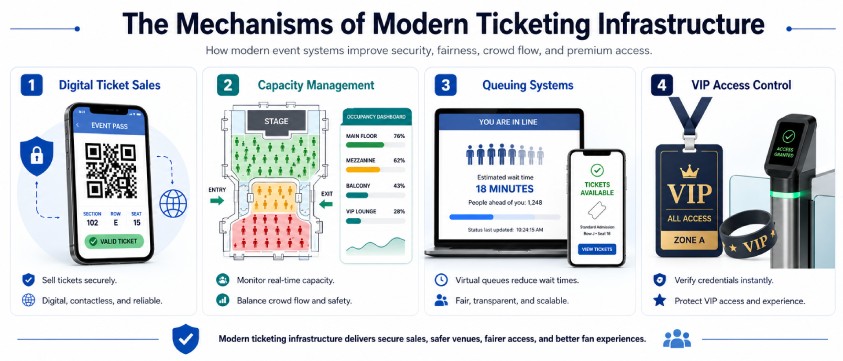
The Mechanisms of Modern Ticketing Infrastructure
To a convention attendee, holding a ticket is like having the key to a vault in a bank. After all, it unlocks all sorts of opportunities, from panel discussions to meet-and-greet sessions. So, you can imagine just how devastating it can be for a fan to buy a ticket, only to face challenges on the D-day. That is why modern ticketing heavily relies on the following aspects:
Digital Ticket Sales
In 2022, many Katsucon fans who had not been able to buy tickets from the official site chose to buy tickets from third-party sites. Unbeknownst to them, many of these tickets were being sold by fraudsters who had printed their own badges that matched the official designs. These fans proceeded to use the physical passes and only realized they were fake when the security systems flagged them.
While we would like to say that this is a rare occurrence, the truth is that it occurs quite often in conventions, especially where the organizers rely on physical sales. Not only are these ticketing systems subject to a high risk of manual errors, but they also introduce the risk of counterfeit badges. After all, fraudsters can easily make their own versions and sell them to fans who would be none the wiser. And to add to this, physical sales restrict sales to people who can access the ticketing office, which locks out fans from other regions.
To avoid these and other ticketing issues, many conventions have digital ticketing platforms that allow fans to buy tickets ahead of the event. These platforms are integrated with various global payment systems, thus enabling fans to pay for tickets securely. And once they have paid for them, they receive secure non-reusable QR codes in their phones, which they can store in their online wallets or link to their specific convention ID account, thus ensuring that other people cannot use their tickets.
Advantages to Fans and Organizers
Aside from enabling conventions to reach a global market, online ticketing solves a very real problem, which is the duplication of badges and the counterfeiting of the same. After all, if a fan wants a real ticket, they can only get it from the official site. As such, fraudsters who would usually target attendees at the gate no longer have a way to defraud them. However, we should add that some fraudsters set up fake official websites to scam fans, but conventions address this by making their official sites known on all their official channels. Online ticketing also allows fans to buy their passes in advance, thus giving them enough time to book other things, such as flights and accommodation, months before the event.
How About Scalping?
While digital ticketing comes with advantages, it has introduced a new problem where scalpers are able to use computer programs to buy thousands of badges, which they can resell on third-party websites at unreasonable prices. These incidents price out many fans and put a damper on the convention leading up to the event. Ticketing platforms have been addressing this through the use of purchase limits, such as 2 badges per member ID, alongside anti-bot tests. To make it even harder for scalpers, many conventions are now using closed-loop technology that ties badges to specific fan profiles, thus ensuring that if the said fan cannot attend the event, they can only resell or return their ticket through the convention’s official marketplace. This way, tickets remain available to fans at affordable prices.
Capacity Management
While conventions sometimes receive poor feedback resulting from safety hazards and fire code violations, they can also receive negative reviews from poor crowd control. Take the 2026 MomoCon in Atlanta as an example. On one hand, the event organizers were celebrating hitting a record of over 62,000 attendees. But on the other hand, they were dealing with crowd control issues resulting from this boost in numbers. Not only were large groups standing around, making it harder for people with mobility aids to get around, but the event was also plagued by poor line management and congestion in the exhibit hall and arcade. To make matters worse, many guests complained that there was insufficient seating space, which forced them to sit on the floors or walkways, thus contributing to the congestion in the hallways.
These are some of the issues that can arise when eager fans rush into an event, and yet the organizer does not have systems in place to manage a large number of people. In some cases, this results in some minor setbacks that leave fans disgruntled. And in others, it paves the way for dangerous situations, such as crowd surges. And that’s not to mention that overcrowded rooms pose enough of a health risk that local authorities can shut the whole event down.
Luckily, this is all avoidable with the help of capacity management, which is something that MomoCon plans on integrating into its future events. Capacity management is all about mapping out the venue’s floor plan and deciding the limits on the number of people who can be in each room at any given time. But it does not stop there. To be effective in keeping track of the number of people, event organizers have to set up scanners at the entries and exits so that fans must scan their badges as they enter and leave these sections. Moreover, they can set up dashboards that display the percentages in each room so as to ensure that both fans and crowd control personnel are aware of the capacity.
Impact on the Event
The most important perk in capacity management is the limit it sets on tickets. You see, where an event has a high demand, event organizers may feel pushed to sell a large number of tickets without taking the size of the venue into consideration. But once they know just how many people the venue can hold without breaking any laws or affecting fan experiences, they can base their capacity on this objective figure rather than just demand. So, they get to improve fan experiences and comply with safety codes, which is the recipe they need for a sustainable convention.
Capacity management also eases traffic flow, especially when integrated with automated scanners and dashboards, as crowd control personnel can keep track of the fans while giving them room to enjoy the experiences in the convention.
Queuing Systems
Taylor Swift’s loyal fans were over the moon in 2023 when she announced The Eras tour. Naturally, millions of them wanted to be part of it, and they prepared to buy online tickets. But their excitement soon turned into despair when the system failed to stagger entries from both the fans and the automated bots that were trying to access the tickets. This failure resulted in site crashes that wiped out selected seats or threw out random codes, long queues that lasted hours for some fans, and tons of errors that left millions of fans with no tickets. Just like that, fans who had been waiting all day for a ticket had nothing to show for it, and the outrage that followed was enough to convince other event organizers to dot all their Is and cross all their Ts.
Servers crashing during ticket sales is not a new thing, and it often happens when millions of people try to access the website at the same time. The massive spike in traffic results in an accidental ‘denial of service’ that not only freezes checkouts but also crashes the servers, which is to the dismay of the fans. Since this does not happen to everyone, it creates an unfair system such that those who are lucky enough to escape these issues end up with tickets.
Queue systems in modern ticketing infrastructure are thus designed to ensure that this does not happen. They create a virtual waiting room that bridges the gap between the fans and the ticket purchases. This way, each time someone tries to buy a ticket, their request is held in this virtual room and assigned a spot on the line, thus creating a natural order. Requests go through the checkout system in batches, e.g., 100 at a time, and with each batch, fans are given a set period within which they should complete their orders, e.g., 5 minutes. Thanks to this, not only are fans able to gauge how long they have to wait in line, but they also get the assurance that, since it is a first-come, first-served system, nobody can take their spot.
The Effect of Queueing
Fairness is vital in the ticketing ecosystem. And with queue management, fans can understand what is happening, which results in an overall positive experience, even if they may not always get a ticket in the end. To add to this, these systems manage fan expectations because they let them in on how long they have to wait, whether tickets are still available, and other aspects that inform their decisions. So, instead of spending time refreshing their browsers or navigating broken pages, they know exactly where they stand.
VIP Access Control
Have you ever bought a VIP ticket only to feel like you did not get value for your money? If yes, you are not alone. One convention after another, it is quite common to come across fans describing their VIP experiences as unsatisfactory. And no, we are not talking about the incidents where VIP packages do not come with all the perks that were advertised, which is also pretty common. Instead, we are talking about the cases where people with general admission tickets are able to sneak into VIP events, such as exclusive panels and autograph lines.
When this happens, we see a loss on both sides. From the VIP fans’ point of view, they feel cheated out of their experiences because they are not able to do everything that was promised to them or are not treated to the ambience that they expected. Thus, not only can they demand refunds after the event, but they are also likely to refuse to pay for a VIP package in the future. After all, if they paid for premium experiences and got the standard package, they may as well embrace the general admission packages.
From the organizer’s perspective, this is a loss in revenue. At the end of the day, VIP packages bring in a lot of money because they allow people to access early entries, front seats to panels, interactions with celebrities, and so on. So, it is not uncommon for these tickets to cost hundreds of dollars compared to general tickets that often cost tens of dollars. Some of these tickets can even be worth thousands of dollars per person. But in a case where general admission attendees are able to enter these exclusive spaces, then the allure of the VIP packages reduces because they essentially stop being exclusive.
Luckily, organizers can prevent this from happening through their ticketing systems, which can mark profiles based on the zones that they can enter. Some ticketing systems do this through colors, while others use scannable badges, codes, or wristbands. Thanks to this, each time a guest tries to access a restricted area, such as a lounge, they scan their credentials or show them to the staff. And if their package allows them to access the said area, then they can walk in.
The Spillover Effect
Access control ensures that the VIP experience remains valuable to the fans who are willing to pay more for exclusivity. And thus, it protects the event’s revenue streams by ensuring that people are willing to pay for these VIP packages year after year. At the same time, it plays a part in crowd control because it allows staff to easily verify whether a person can access a given zone within seconds, thus ensuring that there are no endless queues.