
Brands are so ingrained in pop culture events that attendees expect to see them the minute that they walk through the venue’s gates. But how many brands feature in these events?
Well, if you look at the small regional events, organizers will typically have an average of 100 to 150 brands there, with their focus mainly on local vendors. But when you start moving towards the larger national conventions, this number grows to about 500 to 700, and you start seeing some industry heavyweights and networks in play. And once you get to the mega events, like the San Diego Comic Con, the number of brands crosses the 1,000-line, with a mix of corporate vendors, media, and artists.
Of course, looking at this from the surface, one would assume that brands were there to sell their products. After all, businesses exist to turn a profit. But if you peel back the layers, you soon realize that there is more to their presence than meets the eye. Away from direct market research, user testing, networking, and talent recruitment, brands are often in these conventions to market themselves to a ready market. Let us talk about the ways in which they do this and why they work.
The Marketing Approaches That Brands Use in Conventions
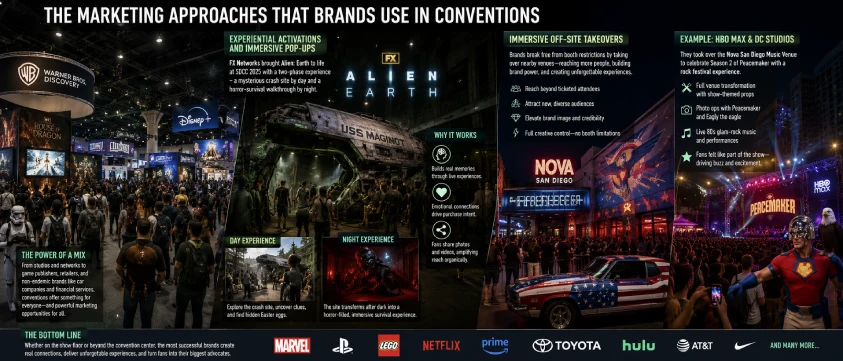
In any convention, you find that brands vary in terms of their setups and products. As such, you have everything from studios and networks to video game publishers, retailers, manufacturers, and print media. On top of these brands, you find that conventions also attract hundreds of non-endemic experiential sponsors whose brands have little to nothing to do with entertainment, and yet they buy into the convention because the attendees match their demographic. Examples here include restaurants, financial services, and even car companies.
Thanks to this mix of brands, attendees get access to a wide variety of products, which enhances their experiences. In return, these brands get to market their businesses and products in the following ways:
Experiential Activations and Immersive Pop-Ups
During the 2025 San Diego Comic-Con (SDCC), thousands of FX Networks fans got the rare treat of walking through a set that was quite similar to what they would encounter in the upcoming series Alien: Earth. With the series being a classic horror sci-fi, FX Networks had their work cut out for them, but they succeeded by coming up with a two-phase experience.
Fans who visited the set during the day were able to walk into a physical representation of the crash site of the USCSS Maginot, where they were cast as investigators who were exploring the debris and uncovering hidden Easter eggs. And those who visited the site at night found that the experience transformed into a horror-survival walkthrough complete with scares and screeching audio.
So, rather than just promoting the new series, FX Networks was able to give its fans a true taste of the Alien franchise, and it was not long before fans were lining up several times just to experience the contrast between night and day. And that right there is experiential marketing.
Why Does It Work?
Traditional marketing often fails because it is a one-way street where brands tell their audience why their product works well. And since their audience only has their word of mouth to go by, they can believe it, dismiss it, or sit on the fence. They can also forget the message entirely within seconds because they have no personal connection to the ad. After all, they come across thousands of such messages each day, and their brains filter out what they deem as unimportant.
Experiential marketing is not like this, which is why brands love it. You see, instead of just telling their audiences why their products are great, brands are able to build physical worlds where their audiences can actually experience the said products. This way, people walk away having established memories, and if these are positive, then they serve as motivation to invest in the products.
But that is not all. Since experiential marketing is a highly unique and emotional experience, people do not just walk through the sets and leave. Instead, they take pictures and videos which they share on their social platforms, thereby marketing the products on behalf of the brand at no cost.
Immersive Off-Site Takeovers
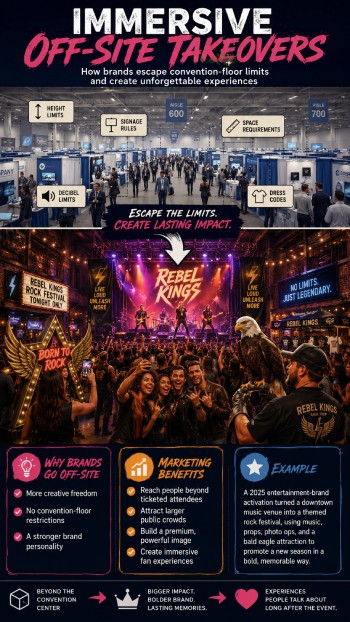
To ensure that brands play nicely with each other as they market their goods, event organizers have to come up with rules that apply to every booth. These include height restrictions, signage limits, space requirements, music licensing, dress codes, and more. For example, a venue may dictate decibel limits on music to ensure that brands do not drown each other out. In the same way, they may limit the heights of linear booths to ensure that the bigger brands do not block smaller brands from being visible.
All these rules are in place to ensure fairness. But while that may be so, the uniformity can be a tad boring and can take away from a brand’s own personality. After all, inside the convention hall, brands may feel like just one booth out of the other thousands, which can make it hard for them to stand out. So, with the restrictions, their visibility takes another hit.
As such, some brands choose to have a booth inside the convention center while also setting up space outside the venue in a nearby space like a restaurant or warehouse. Inside the convention, they play by the rules, but outside, they get full control over marketing, be it in lighting, branding, music, or scheduling. Best of all, they get to do this without infringing on the rights of their neighbors.
But how does this translate into marketing exposure? Well, for one, brands are able to reach more people this way. Seeing as convention tickets are often expensive and limited, many people get locked out of the venues. But public spaces like restaurants are open to everyone, which allows brands to attract bigger crowds, including people who likely would not have gone to the convention. Secondly, the simple act of leasing out or owning a dedicated space helps the brand improve its image as it comes off as powerful and wealthy, thus making it look like a reputable business.
Example
HBO Max and DC Studios pulled off an impressive takeover in 2025 at the Nova San Diego Music Venue. Their goal was to mark the second season of Peacemaker. But given that the San Diego Convention had more of a family-friendly vibe, they knew that the venue would not augur well with their series.
Thus, they chose to set up at a downtown music venue where they could host a rock festival without breaking the convention rules. Here, they were able to redesign the entire venue to match Peacemaker’s aesthetic with props that fans could use for photo ops. They even included a trained bald eagle named after Peacemaker’s sidekick, Eagly, who interacted with the fans.
With these unique touches, audiences felt like they got to be part of the cast while singing along to the live music that was reminiscent of the 1980s glam-rock pop-up experiences. And in so doing, HBO Max and DC Studios were able to successfully market the new season without making their audience feel like they were looking at yet another billboard.
Exclusive Product Drops and Limited Merchandise
On 24th September, 2025, Mondo announced that it would be launching Spider-Man: The Animated Series 1/6 Scale Figure. Seeing as Mondo was already known for its high-end figures, Spider-Man fans could not wait to get their hands on the figures. But there was a catch. Mondo had two versions of the figure – the standard edition and the deluxe limited edition. The latter option was capped at only 1,500 units. And given that it came with exclusive accessories such as an unmasked Peter Parker head, fans wanted it even more, and that resulted in online queues the minute that it dropped.
Weeks later, during the New York Comic Con, Mondo decided to ride this wave by announcing that it would be selling the 1/6 Scale Daredevil Limited Edition Variant, which was a twist on the previous variant. This version came in at $225 and had all the makings of a collectible. Once again, there was a catch as Mondo limited their physical stock and synced their physical launch with their online store preorder windows. Thus, in just minutes, stock had run out both online and in person, creating the kind of exclusivity that would leave people talking for months until they launched their limited edition on their official store months later, capping the stock at only 250 units. Either way, only a lucky few got their hands on the products.
So, why would a brand do this instead of just selling thousands of units to an already excited audience?
The Beauty of Scarcity Marketing
We live in a world where we can place orders in just one click and have the products delivered to us on the same day. Whether we are buying new shoes, ordering a set of cutlery, or even replacing our beds, there are multiple vendors out there who are eager to stick to their same-day delivery promises and who will stop at nothing to keep us satisfied. As such, people have gotten used to convenience, and they barely feel the need to rush to buy anything immediately. After all, they can put off purchases to the last minute and will still get the products they want. But the problem with this is not just the procrastination. It is also the loss of interest. When people know that a product will be available when they want or need it, they do not see the need to purchase it, and its value takes a hit.
Exclusivity addresses this in two ways. First, brands create a high-quality product that they know their audience will love. Then, they limit access to it in some way, be it in terms of where people can buy the product or the number of products available. In conventions, it is quite typical for brands to do both of these things. And since people do not like missing out on things, they do not wait around and instead gear up for the launch of the product to make sure that they are in line when the sales start. Even before the convention starts, talks around the exclusive drop start gaining traction in favor of the brand because this guarantees them a queue at their booth.
This scarcity also drives up the value of the product because once people see others lined up in a convention, they assume that the product at the end of the line is valuable. So, even if they may not have enough information about it, they join the line, creating a chain reaction.
But doesn’t the hype decline after the convention? Not quite. When brands create a valuable product, the items end up on resale sites or collections where their values go up because people see them as rare. And this rarity keeps the brand relevant, enabling it to stand out in a competitive market.
Star-Studded Panels and Surprise Reveals
For years, brands have been doing their best to make their product announcements memorable enough to serve as historic moments. From press releases to YouTube videos, they have tried their hands at various things. But while these worked really well in the past when digital media was still new, they tend to fall flat in today’s age, where people’s attention is drawn to different things. Of course, bigger brands can still capitalize on these methods because of their huge reach, but for most brands, these approaches do not translate into the numbers they want to see.
It therefore comes as no surprise that many brands have been partnering with celebrities and content creators to announce their products in unique ways during conventions. One particular trend that has been picking up has been the inclusion of surprise guests, such as content creators and celebrities, in panels who announce the new product launches. Since audiences already adore these stars, they associate the products with star power and are thus likely to buy the products based on this association alone. What’s more, since bloggers and journalists are often in the audience, they pick up the launch announcements and post them on their platforms, thus sharing the news with millions of people who may not be at the convention. And as soon as people start talking about which content creator or celebrity was seen partnering with a brand, then the social media discussions result in higher engagement for the brand.
Partnering with celebrities and content creators also allows brands to borrow some credibility. You see, creators and celebrities have loyal fan bases who look up to them for their qualities. For example, a content creator may be known for their creativity and humor. But that is not all. These creators and celebrities have built online and offline communities filled with people who support them and the work that they do. As such, by simply working together with these people and being seen out and about with them, brands establish themselves as trustworthy and are able to humanize themselves in ways that traditional ads cannot. Thus, it is quite common for fans of the creators and celebrities to engage with the brand’s content out of curiosity or to support a brand they believe is supporting a person that they love.
Examples
During the 2025 Star Wars Celebration Japan, fans were surprised when Sam Witwer stepped onto the stage as a surprise guest. As a fan favorite, he brought the panel to an exciting pause. But nothing could have prepared the fans for the announcement that he would be returning as the voice of Darth Maul.
But it is not just media companies that know how to bring the house down. When Samsung was showcasing its Galaxy S24 Ultra smartphones during the San Diego TwitchCon in 2024, they had celebrities like Ludwig who played live at the booth, thus showing off how powerful the phones were.